Senera 2026.37

Reach every worker. Know what your assistant knows.

Two big additions in one release. Senera can now reach your workforce on the channel they actually read — SMS, Viber, WhatsApp or email — with consent you can prove and spend you can cap. And the new Knowledge Atlas finally answers a question every AI assistant dodges: which of your documents is it actually reading, and which is it quietly ignoring?

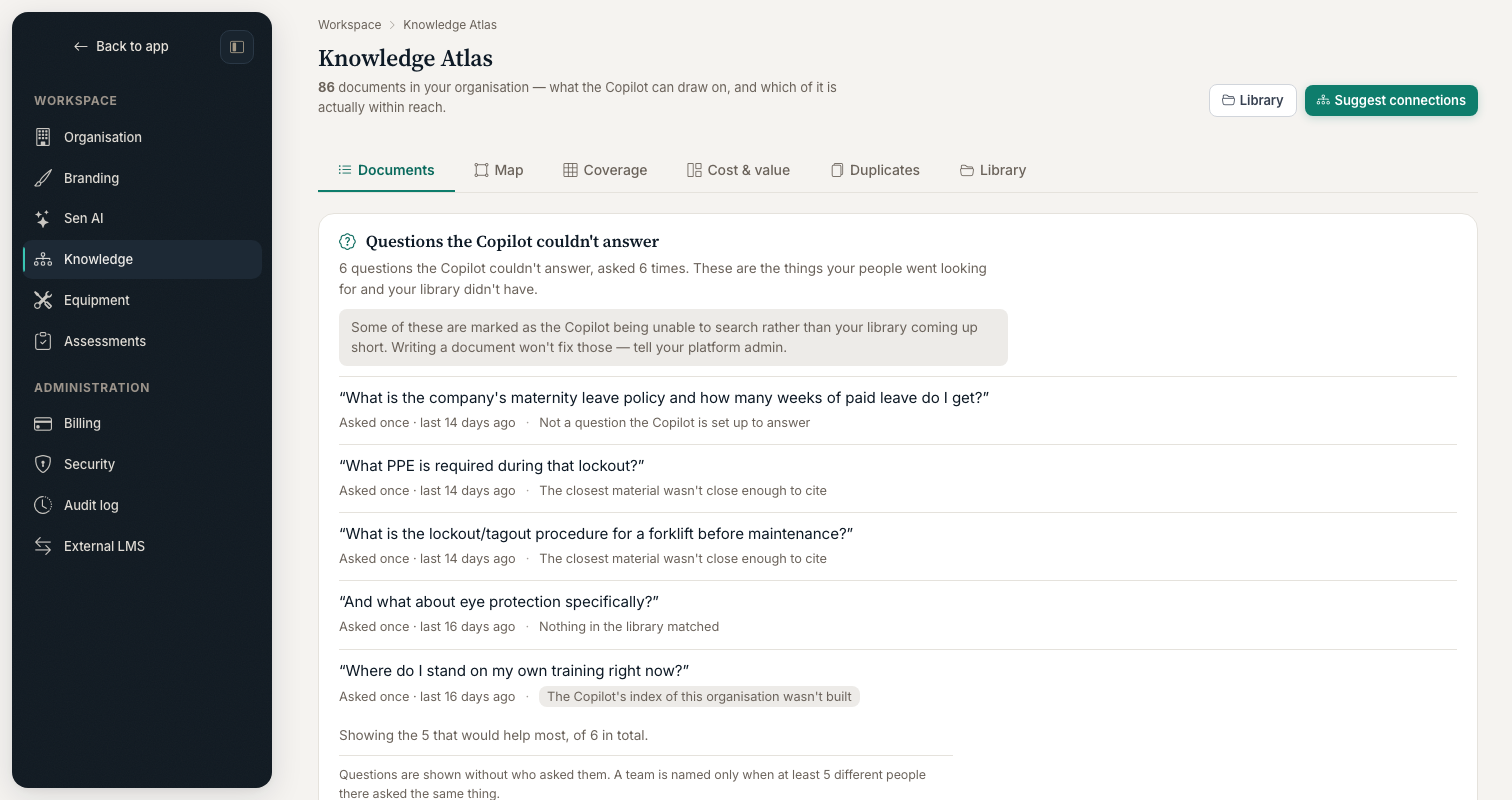
The Knowledge Atlas — what your assistant can read, and what it cannot — screenshot

The Knowledge Atlas — what your assistant can read, and what it cannot

Your documents are the ground your assistant stands on. The Atlas maps that ground — which documents are connected to real work, which are sitting unused, which are duplicates, and which you are paying to store and nobody ever reads.

  • See every document you have given Senera in one map — what the assistant can answer from, and what it cannot.
  • Anchor a document to a team, a machine, a competency or a course, so its answers know where they apply.
  • The Atlas builds itself — anchors come from the relationships already in your workspace.
  • Duplicates are caught before they confuse an answer, with one place to review and resolve them.
  • Rename, archive, restore, pin or re-index a document in place. Archive now genuinely removes it from answers.
  • See the questions your assistant could not answer — so you know which document is missing.
  • Find the documents nobody's answers ever use, and stop paying to store them.

Reach your workforce where they are — SMS, Viber, WhatsApp and email

Training reminders and escalations only work if they are read. Senera now sends on four channels, with per-organisation choice, spend controls and working-hours respect built in.

  • Four channels — email, SMS, Viber and WhatsApp — switched on per organisation.
  • Send a message straight to a team, a site, or named people.
  • Choose the channel worker notifications go out on.
  • Message allowances come from your licence, with caps and live counts you can see.
  • Working hours are respected — no 3am text to the night shift.
  • One daily digest instead of the same reminder three days running.
  • Consent is recorded with its source — the worker's own agreement, or a signed induction an admin logged — so you can defend it in an audit. Opt-out is honoured everywhere.

Equipment that knows what it takes to operate it

A machine is not just an asset record. It now carries the competency required to run it and the procedure for running it safely.

  • Require a competency on a machine — so readiness reflects who may actually operate it.
  • Attach an SOP to a machine and read its procedure out in place.
  • Assign equipment to a site directly from the create and edit forms.

Readiness you can defend in an audit

A readiness status is only worth having if you can show how it was reached. Every status now carries the threshold it was measured against and the period it was measured over — so an auditor's "why is this person green?" has an answer on the screen.

  • Every status shows the threshold it had to clear, and the period it was judged over.
  • See at a glance who is cleared to operate what, across your whole workforce.
  • Group and site figures only ever speak for the people they actually cover.
  • Compliance exports carry the score and the threshold behind it, not just a pass or fail.
  • Assessment history is dated by what happened, not by when the record was created.

Easier to use, for everyone

  • A platform-wide accessibility pass — clearer focus, larger touch targets, and stronger colour contrast on every page.
  • Keyboard and screen-reader navigation now behaves properly when dialogs and panels close.
  • Messages and errors appear as clear in-product notices, never a raw browser popup.

Workforce records

  • Employee numbers follow one consistent format, and duplicates are caught before an import lands.
  • The roster can add a language to a worker, and can never silently remove one.
  • Bulk invite tells you exactly which rows it skipped, and why.

Course authoring

  • Review translations before a course goes out, not after.
  • Re-attach a file you have already uploaded instead of uploading it twice.
  • Your organisation's own documents now load as quickly as course content.

Platform

  • Messages and message delivery stay hidden for organisations with messaging switched off.
  • New downstream health checks so we hear about a dependency problem before you do.

What we're building — every release. — The Senera team